_edited_edited.png)
Tile Sizes & Shapes: The Interior Design Decision That Affects Everything

So you're standing in a tile showroom in Israel — maybe it's your first time, maybe your fifth — and you're completely overwhelmed. There are tiles the size of a yoga mat next to tiny little mosaics, hexagons, fish scales, subway tiles, giant rectified slabs... and nobody told you that the size and shape you choose will ripple through your entire renovation budget.
Let's fix that. Consider this your friendly, no-fluff breakdown of why tile sizing is one of the most important decisions you'll make — and why it matters way more than just aesthetics.
Size Matters (And Not in the Way You Think)
Here's the thing most people don't realize: bigger tiles are often cheaper to install. I know, counterintuitive, right? You'd think a giant porcelain slab would cost more in labor than a bunch of small tiles. But flip that logic around.
When a tile layer (called a ratzaf) is laying a large-format tile, they're making fewer cuts, placing fewer individual tiles, and doing less grouting. Fewer seams = less time = less money on labor…with a few exceptions that we will get to a little later.
Now think about a mosaic backsplash with 2x2cm tiles, or a beautifully intricate Moroccan zellige pattern. That ratzaf is now placing hundreds — sometimes thousands — of individual pieces, cutting around outlets and corners constantly, aligning grout lines obsessively. The labor time doubles or triples. And in Israel, labor is typically charged by the square meter, but complex work gets negotiated upward — especially if your tile layer sees what you're bringing in.

The general rule:
Large format floor tiles (60x60cm and up, but not too large which then get heavy and leads to expensive labor): standard labor cost per sqm
Mid-size tiles (30x60, 45x90, 60x120): Standard labor rate
Small tiles, mosaics, zellige, hexagons, penny rounds: Expect to pay a premium — sometimes 30–60% more in labor alone (not to mention the price difference in the tiles themselves)
The Israel Factor: What American Clients Need to Know
If you're coming from the US and renovating here in Israel, the tile world is going to feel both familiar and completely foreign. As an interior designer in Israel with years of experience, let me bridge that gap for you.
In the States, you're probably used to walking into a Home Depot or tile showroom, picking something off the shelf, and it showing up at your job site in a few days. Israel doesn't work that way.
The Israeli tile market is heavily influenced by European (particularly Italian and Spanish) manufacturers, and a lot of what you see in showrooms here is either imported or domestically produced under license. Israeli brands carry solid options, and the country has genuinely beautiful local stone — Jerusalem stone, travertine, and limestone — that you simply can't get at the same quality or price anywhere else. That's one of the hidden gems of renovating here, and I love it every single time. Another advantage is that since Israel is so close to Europe, sourcing tiles and other European materials can be affordable since there are lower transport and customs costs shipping to Israel rather than the US.
But here's the adjustment: lead times are real. If a tile is out of stock or needs to be ordered, you could be waiting 4–8 weeks, sometimes more. Plan your tile selection early — like, before you even finalize your floor plan early. I've had clients fall in love with a tile in week one of a project only to find out it needs to be ordered from Spain and won't arrive for six weeks. Build that buffer in. Aside from the delivery times, it's better to plan the tile selection early to allow the contractor to price out his costing according to the specific tile chosen. That way there are no surprise labor costs for you to contend with after.
Also worth knowing: tile is almost always sold by the square meter here, not by the box or by the tile (unless you are buying exclusive and unique tiles). When you're calculating quantities, Israeli contractors will typically add 10–15% waste factor for cuts and breakage. Don't skip that buffer — running short on a discontinued tile mid-project is a nightmare I wouldn't wish on anyone.
Flooring: Go Big (Seriously, Go Big)
For floors — whether that's a main living area, bedroom, or hallway — large format tiles are having a serious moment in Israel right now, and honestly they're smart on multiple levels.
The most popular tile sizes and shapes for flooring right now amongst interior designers in Israel are 100*100 and higher. 60*120 is now standard. Apartments on paper still sell 60*60 or 80*80 but this is now considered out of style. You'll also see 120x120cm and even larger slabs in high-end projects. Here's why they work:
Visually: Large tiles make a space feel bigger and more open. Fewer grout lines = less visual "noise." In Israeli apartments, which tend to have smaller rooms than American homes, this is a huge win.
Practically: Less grout = easier to clean. Anyone who's tried to scrub old grout lines in a 30x30 tiled kitchen floor knows exactly what I'm talking about.

One thing to watch out for with large format tiles: the subfloor prep has to be perfect. In Israeli apartments — particularly older buildings — the concrete subfloor can be uneven, and large tiles will telegraph every imperfection. A good contractor will level the surface before laying anything. If your contractor or tiler skips this step, you will later get a cracked floor or lippage (that annoying....). A good project manager and quality contractor would never consider skipping this step of floor prep.
For outdoor spaces and mirpeset (balcony/terrace) flooring, you want tiles rated for outdoor use — look for slip resistance ratings and frost resistance if relevant. Many clients try to match their indoor and outdoor tile for a seamless look, which is gorgeous, but make sure the tile you love for inside also comes in an outdoor-rated version. Not all do.
The Real Talk on Costs: Israeli Renovation Edition
Let's get into numbers, because I know that's what you're really here for.
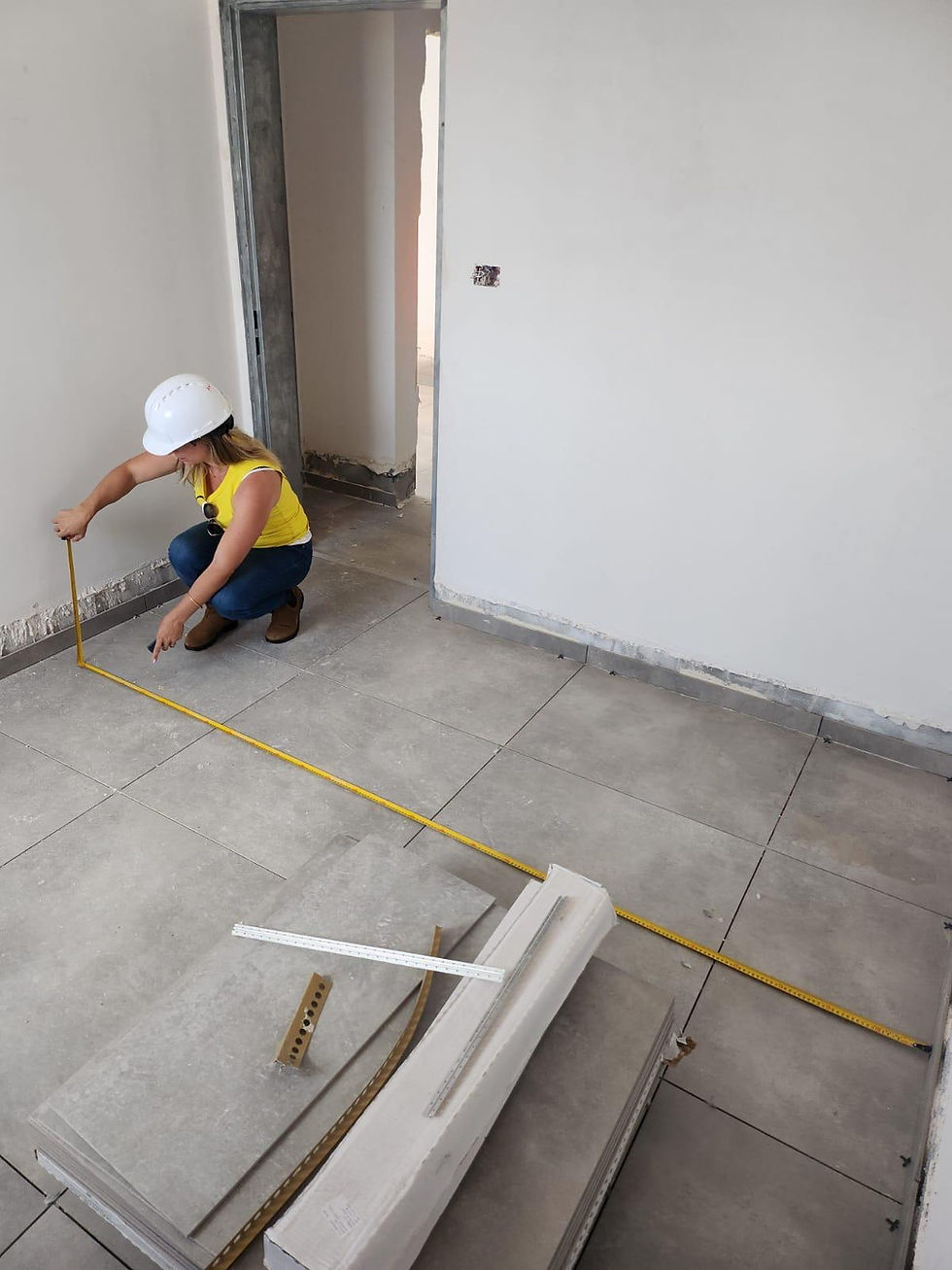
Tile prices in Israel vary widely, but here's a rough framework to orient yourself (prices in NIS per sqm, as of recent market conditions — always verify current pricing with suppliers):
Basic domestic porcelain (floor/wall): ₪50–₪120/sqm
Mid-range imported porcelain: ₪120–₪250/sqm
Designer/large format/imported premium: ₪250–₪600/sqm
Natural stone (marble, travertine, local limestone): ₪200–₪800+/sqm depending on origin and finish
Zellige and specialty handmade: ₪400–₪1,200+/sqm (material only)
Labor prices vary widely between different contractors and get much more expensive the more complex patterns the tiles get. And then there's the thing nobody talks about until you're mid-demo: the cost of removing existing tile in Israeli apartments. (You can also opt to glue the new tiles on the existing tile floor for lower costs).
Reflooring in Israel: What to Expect
This one's for my clients who are buying an older Israeli apartment and want to update the floors. Buckle up, because this process is different from what you might know from the US.
In American renovations, if you want new floors, you often have the option to lay new material over existing flooring — especially with hardwood, LVP, or even thin tile-over-tile systems. In Israel, that option is much more limited, especially in apartments.
Here's why: Israeli apartment construction typically has strict ceiling height and floor level continuity concerns, particularly in buildings where multiple units share structural slabs. More practically — Israeli apartments almost universally have a concrete screed layer beneath the tile, and the tile is set directly into that screed with adhesive. To retile, you almost always have to demo the existing tile first. While you can retile over existing tiles, it is not recommended in old buildings and old apartments.
Tile demolition (פירוק ריצוף) is loud, dusty, disruptive, and costs money. And yes, there can be multiple layers — I've seen apartments with three generations of tile stacked on top of each other.
After demo, you'll likely need some level of screed repair or re-leveling before new tile goes down. This adds time and cost but is genuinely necessary for a quality result.
The full reflooring process in an Israeli apartment typically looks like this:
Demo existing tile — noisy, a few days depending on size
Repair and level the screed — add time for drying/curing
Waterproof wet areas (shower, bathroom floor) — non-negotiable
Lay new tile — timing depends on size of space and tile complexity
Grouting — done after adhesive cures
Sealing (if using natural stone or unglazed tile)
For a standard apartment renovation in Israel, flooring alone — including demo, prep, tile material, and labor — can run anywhere from ₪400–₪1000/sqm total depending on your choices. Yes, that adds up fast. Yes, it's worth budgeting for properly.
My Bottom Line Advice
If you're renovating in Israel and trying to balance budget with beauty, invest in large-format, good-quality porcelain. It photographs well, wears well, and is cost-efficient on labor. This isn't where I'd scrimp on material quality — you walk on it every day.
And always, always, always, buy extra tiles. Keep a box in storage. Israeli tiles get discontinued, dye lots change, and the day you crack a floor tile three years from now, you'll be so glad you have a spare.
Renovating in Israel is one of the most rewarding experiences. The products available here are genuinely incredible, the craftsmanship (when you find a good contractor) is excellent, and there's something special about designing a home in this country. My job as a seasoned interior designer in Israel is to make sure the process feels less foreign and more like yours.


Comments