_edited_edited.png)
The Real Deal on Custom Carpentry in Israel: What You Need to Know Before You Build

You will be surprised to find that one of the most exciting, and most misunderstood, parts of any home renovation is custom carpentry. I'm talking closets, vanities, storage walls, built-in shelving, those gorgeous under-stair niches you've been screenshotting on Pinterest for the past two years. The stuff that takes a house from "fine" to "wow, who lives here?"
If you're renovating in Israel, whether you've just made aliyah, you're building a vacation home, or you've been here for years and are finally undertaking that project, it is crucial that you understand something upfront: the carpentry world here operates completely differently than what you're used to back in the US, Canada, the UK, or pretty much anywhere else you might be coming from. And if nobody tells you this before you start, you're going to be in for a very expensive, very frustrating surprise.
So let me tell you.
First Things First: "Custom" Means Something Different Here
Back home, custom carpentry is everywhere. You want a built-in entertainment unit with specific dimensions, a particular finish, some floating shelves at an exact height with integrated cable management? You call a carpenter, they come, they measure, they build it to your spec. Maybe you pay a premium, but it's done, it looks seamless, and it fits your space like it was born there.
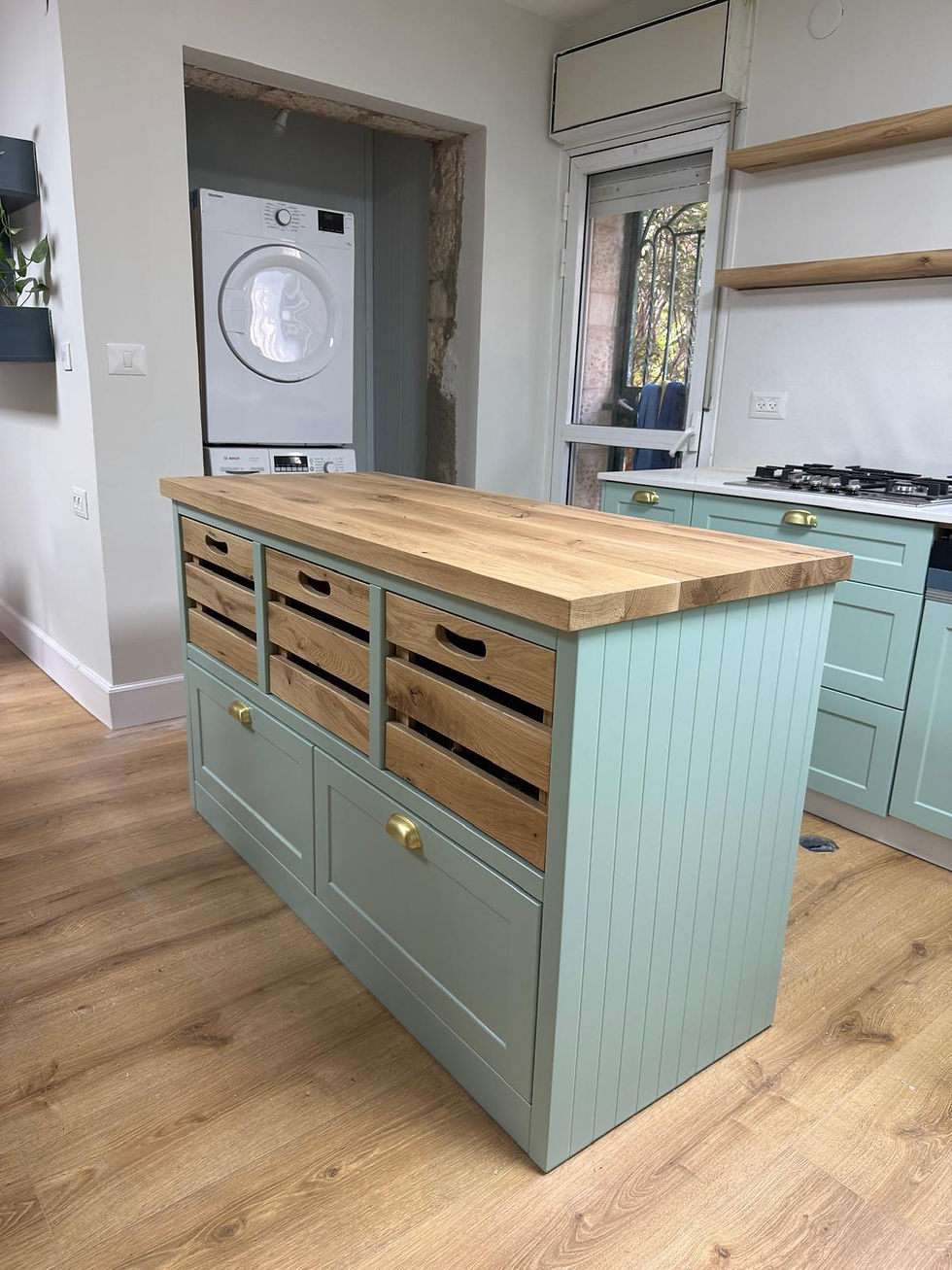
You can go to Home Depot and choose between dozens of do-it-yourself custom carpentry kits that are easy to put together and gorgeous when installed.
In Israel, there are two real options: standard (prefab, catalogue-based, modular systems like those you'd find at the big Israeli suppliers) or truly custom (hand-built by a skilled carpenter, from raw materials, to exact specifications). That middle ground you might be imagining, the "I'll just find a less expensive carpenter who can knock this together affordably" option, simply does not exist here in the way you're picturing it.
Truly custom is expensive. Full stop. There are no hacks. There is no "budget custom." You either go modular (IKEA) or you pay for real craftsmanship, because the labor costs, import material costs, and the market just don't support a middle tier the way other countries do.
There is no way around it. And in my experience- people who try to find a way around it, get burned. As they say: you get what you pay for.
But knowing it upfront means you can plan for it, budget for it, and make smart decisions instead of hitting a wall halfway through your renovation.
Carpentry is one aspect of building where a designer is a true necessity. To help prioritize between pre-fab ready made cabinetry, and fully custom, and how to make it affordable in between. Our profession is to ensure that whatever system you decide to use, we maximize to its full potential and configure correctly, so that it actually makes sense for your specific space and lifestyle.
All About Closets
Walk-in closets. You love them. I love them. Everyone loves them.
Israeli contractors? They are confused by them. They think that walk-in closets are a less optimal use of the space (as opposed to wall closets) and they don’t understand why we love them.
This is not an exaggeration. The standard closet in Israeli construction is a wall mount built-in wardrobe with a few drawers, interior shelving, and a hanging rod. It's functional, compact, and usually makes more sense for the smaller home sizes in Israel. Walk-in closets are not part of the standard vocabulary of Israeli construction.
So when you tell your contractor or carpenter that you want a walk-in closet, one of two things happens: either they don't really understand what you mean and they build you something that is technically a room you can walk into but is in no way a functional, well-designed closet, or they understand the concept but have zero experience with how to make one actually work, and again, you end up with something that looks okay on a floor plan but fails completely in practice.
A walk-in closet isn't just a room with clothes in it. It's a system. It's about understanding how you and your household actually use clothing and accessories, how much hanging space you need versus folded storage, whether you need a full-length mirror and where it should go, how lighting interacts with the space, how the layout flows. It requires thought through all of these things and a design that works.
That's true whether you're doing a custom built walk-in from scratch or using a modular system configured into a walk-in layout. Either way, the design thinking has to happen first.
I've helped clients design walk-in closets that use modular components and look completely intentional and beautiful. I've also helped clients invest in full custom build-outs when the space demanded it. But in both cases, the carpenter alone, without a designer guiding the process, was not going to get there.
Vanities, Storage Walls, and everything else
Let's move beyond closets and talk about some of the other carpentry elements that can really elevate a space, and where the same rules apply.
Bathroom vanities are a great example. In Israel, you can absolutely find beautiful prefab vanity options. And I almost ALWAYS tell clients that there is no reason to create custom-made vanities. But if you have a non-standard bathroom, an unusual width, or a layout where the sink position creates an awkward asymmetry, a prefab vanity is going to not exactly fit. Custom vanity work can solve this, but again, it costs what it costs, and you need to budget accordingly.

Storage walls, the kind that span an entire room, integrate with your TV setup, have a mix of open shelving and closed cabinetry, maybe some integrated lighting, are entirely achievable in Israel. But they require careful planning because you're typically combining modular components in ways that need to read as cohesive and intentional rather than assembled. The details matter enormously: consistent reveals, proper handling of ceiling height and A/C systems, the relationship between open and closed storage, material and finish choices. Get these right and it looks like it is a part of the wall. Get them wrong and it looks like a collection of furniture that happened to end up on the same wall.
Built-in seating with storage? Absolutely doable. Window seats, banquettes, benches at the entry, these are all within reach, but they sit in that "truly custom" category, which means they need to be planned from the start and budgeted for properly.
Under-Stair Niches: Making best use of awkward space
If you have stairs in your home, you have one of the most exciting and most challenging carpentry opportunities in the entire house: the under-stair space. In the US or Europe, you've probably seen these done beautifully, built-in reading nooks, wine storage, a home office, a mudroom, a library wall, a powder room. The possibilities are genuinely stunning.

In Israel, this space is often completely ignored or worse, finished in a way that just closes it off without doing anything useful with it.
Here's the challenge: under-stair spaces are always non-standard. The angles change, the heights shift, every section of the space has different dimensions. This is exactly the kind of situation where modular systems are not possible and where custom carpentry earns every shekel. Because you can't slide a prefab unit into an angled, variable-height space. You need something built for that exact space.
If you have an under-stair area in your home, put it in the budget as a custom carpentry line item. Plan for it early, design it thoughtfully, and work with professionals who understand both what you're going for and what the Israeli carpentry market can actually deliver. Done right, it becomes one of the most functional features of your home. Done wrong, or not done at all, it's a dusty, cobwebby corner that vaguely haunts you every time you walk past it.
So What Does This All Actually Mean for Your Renovation?
Whether you're in the early planning stages or already mid-renovation and trying to figure out why things feel more complicated than you expected:
Budget for carpentry honestly. Don't compare what something costs in the US and assume or hope that you can replicate it for the same price here with a bit of creative sourcing. Custom work costs what custom work costs, no matter how creative your sourcing is. Build that into your numbers.
Plan before you build. Carpentry decisions that are made on the fly, where someone just eyeballs a space and starts building without a detailed design, almost always result in something that works but doesn't shine. The planning stage is where good design happens, and skipping it is how you end up with results that feel "almost right" but not quite.
Don't assume your carpenter will design your closet or storage system. They will build what you tell them to build. If you don't give them a well-thought-out design, they will default to what they know, which is likely not what you're envisioning. Get a designer involved, especially for walk-ins, complex storage walls, and any space with unusual dimensions.
Know when to go modular and when to go custom. Standard spaces can be beautifully served by modular systems when they're well-designed. Unique spaces, irregular dimensions, architectural features, non-standard layouts, will often need custom work to look truly intentional. Be honest with yourself about which category your space falls into.
Understand the market. Israeli craftsmanship is genuinely good. There are talented carpenters and excellent suppliers here. The difference from what you're used to is less about quality and more about the way the market is structured and what's considered standard practice. Once you understand those differences, you can work with them rather than be frustrated by them.
My Bottom Line
Custom carpentry in Israel is one of those areas where the gap between expectation and reality can be really significant, especially if you're coming from a place where a quick call to a carpenter or a stop over at a hardware store could get you exactly what you wanted at a reasonable price. That's not the reality here, and pretending otherwise is just going to lead to headaches.
But here's what I genuinely love about working with clients on carpentry in Israel: when it's done right, when the planning is solid and the budget is realistic and the design is thoughtful, the results are absolutely stunning. Israeli craftsmanship at its best is beautiful. A well-designed custom closet, a seamless storage wall, a perfectly integrated under-stair library, these things transform how a home feels and functions.
You need to go in with realistic expectations and ideally someone in your corner who can bridge the gap between what you're dreaming of and what the local market can actually deliver.


Comments